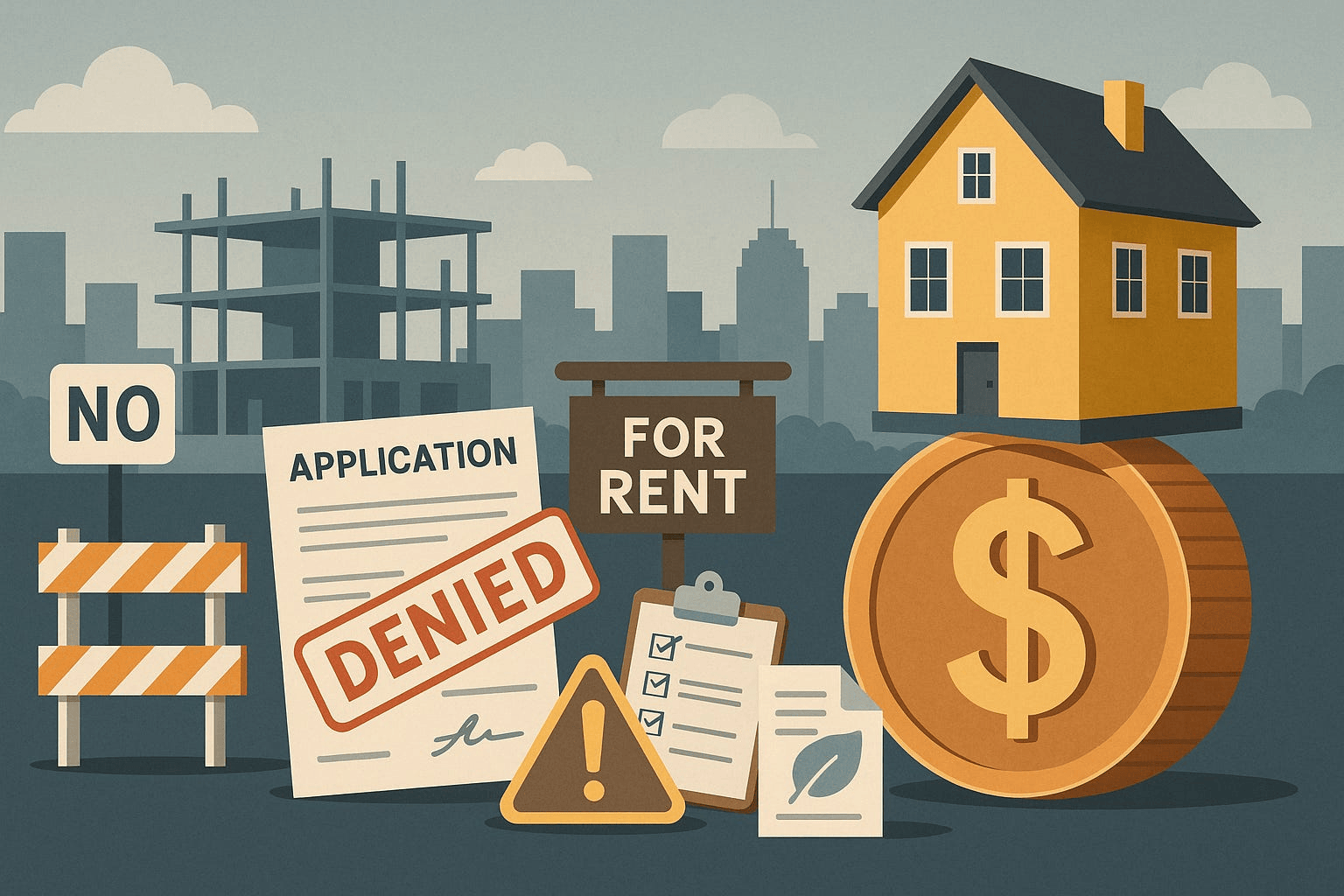
America’s housing affordability crisis is self-inflicted by policy. Easing zoning, streamlining permitting, curbing onerous reviews, and avoiding heavy-handed price controls would make housing more affordable for millions.
The rank order of impact is clear:
- Zoning and land-use limits have by far the largest effect on housing prices nationally (especially in constraining supply in high-cost regions),
- Permitting and review delays come next (significantly adding to costs and slowing new supply),
- Rent control has a more localized but meaningful impact (distorting rental markets in big cities), and
- Compliance with rules and regulations
- Other regulatory burdens also add up (building codes, environmental reviews, etc.), but are less of a driver than pure supply restrictions.
These policies make housing more expensive and the market less efficient. Economists estimate that rolling back these constraints to a free-market baseline would yield enormous benefits. Housing would be more plentiful and cheaper.
Hsieh and Moretti’s work implies that U.S. median housing prices could fall dramatically in high-cost cities (potentially on the order of 20–50% lower in places like San Francisco or Manhattan if artificial scarcity were removed), and U.S. GDP would be higher by several percentage points (they found 36% more growth over decades, equating to trillions in output).
In pure dollar terms, freeing up housing markets in just a few key cities could add $1–2 trillion per year to the economy by enabling millions of Americans to live where they are most productive and spend less on rent/mortgages. A more conservative study says the gain would be $440B/yr. No one ever meant for the world to be this way. It’s the effect of thousands of well-intentioned, ill-thought-out policies over generations.
Zoning
Zoning laws (limits on density, height, lot size, land use, etc.) are the #1 contributor to expensive housing by constraining supply.
The median Manhattan condo price includes a “zoning tax” that accounts for over 50% of the unit’s total price. This means more than half the cost is attributable to land-use constraints rather than building expenses.
In other coastal cities (San Francisco, Los Angeles), similar gaps exist: by the late 1990s, 77% of homes in Western U.S. cities were priced at least 40% above their construction costs, indicating a huge implicit cost from land shortages caused by regulation. These patterns reflect how single-family zoning and density caps restrict the housing supply, leading to inflated land values and prices. Areas with more restrictive zoning have higher home and land prices.
Permitting
40.6% of development costs come from our regulations (fees, standards, delays). One recent analysis finds that regulatory costs account for 24% of the final price of a new single-family home in the U.S.
In recent years, the median approval timeline for large multifamily projects was 13 months in Los Angeles, 30 months in New York City, and 33 months in San Francisco. A study in Washington State found the average permitting delay is 6.5 months, which adds $31,375 in carrying costs per new home.
Every month of delay forces builders to pay additional interest, taxes, and overhead. All these costs are passed to buyers. In Washington, every $1,000 increase in price means 2,200 families can no longer afford a home. So the typical delay ($31K in cost) prices out 69,025 would-be homebuyers statewide. This is emblematic of the cost of permitting delays nationwide.
Environmental Reviews
Environmental reviews compound these delays. U.S. Clean Water Act permits for building near wetlands take upwards of one year to obtain, and if a project triggers an Endangered Species Act review, it can add several more years of consultation before construction can start.
California’s notorious CEQA (California Environmental Quality Act) exemplifies how well-intentioned environmental rules are used to stall housing development. CEQA lawsuits routinely target housing developments. In a 3-year period, 14,000 planned housing units (mostly infill apartments) in Southern California were challenged under CEQA. Litigation forces costly environmental impact reports and court delays that deter developers. The result is that projects are either downsized, canceled, or delayed for years, constraining supply and pushing prices higher.
Lengthy permitting and environmental reviews act as a bottleneck on new supply, increasing the time-cost of building and creating scarcity. Faster, more predictable permitting (as in some “by-right” development states) would improve affordability.
Rent Control
In 1994, SF had a 15% reduction in the rental supply of small multi-family housing after implementing rent control. Rent control reduces housing supply and the quality of rentals.
In the short run, rent control can keep some tenants’ housing costs below market rates, but overwhelming economic evidence finds significant long-run costs and inefficiencies. By capping rents, these laws discourage new rental construction and lead landlords to remove units from the rental market. The most common effects are converting rentals to condos, letting rentals degrade in quality to match the rent control price, or keeping them empty to later knock down the building.
Rent control shrinks the rental supply, thus putting upward pressure on market rents citywide. Those without rent-controlled units pay the price for rent control.
Negative Externalities of Rent Control
Argentina recently ended rent control, resulting in an over 100% increase in rental supply. This led to rental declines of 20-40%. Similar effects occur in the US when rent control is abolished. Beyond decreasing rents, it raises property values.
In Cambridge, MA, strict rent control was abolished in 1995. Researchers found that controlled apartments had been renting at 40% or more below market rates prior to decontrol. After rent control ended, property values of those formerly controlled buildings jumped 45%. Nearby uncontrolled property values rose 13%, indicating that rent control had depressed the desirability of whole neighborhoods.
The total value gain from ending Cambridge’s rent control was estimated at $2 billion, yet only a small fraction of that ($300 million) represented the direct benefit that tenants had been receiving in the form of cheaper rent. Over $1.7 billion of the cost of rent control had been an efficiency loss borne by property owners and neighbors (negative externalities like deteriorating buildings and reduced neighborhood appeal).
This shows how incredibly inefficient rent control is as a transfer of wealth. Tenants only receive 15% of the total cost of rent control policies.
In many cases rent control appears to be the most efficient technique presently known to destroy a city—except for bombing.
-Assar Lindbeck
Rent control tends to help a subset of tenants (often higher-income, long-term tenants) while increasing costs for others. In sum, rent control’s net impact is to make the rental market smaller, lower quality, less responsive, and inefficiently allocated.
Compliance
When running a property management firm, you’re complying with Federal Fair Housing as well as state, county, and municipal rules and regulations. Beyond that, real estate companies must comply with their contracts– lease, HOA, vendor, management, etc.
Real estate companies operate in disparate systems that don’t talk to each other. This makes compliance a massive headache for things as simple as resident and vendor communication, which sit in different areas. How can a group be sure every resident is being treated the same if they don’t even have the data to track it?
This is where Ender comes in. We have all your data in a single system, enabling automated compliance. All communication, documents, policies, and SOPs are stored in Ender to ensure you and your team comply. Without Ender, this is a huge cost and annoyance to the industry.
Other Regulatory Constraints (Building Codes, Impact fees, etc.)
That said, Ender can’t fix everything. A host of other restrictions and requirements add cost to housing, though these generally have a more modest impact on prices than the big factors above.
NYC requires two stairwell exits on most construction. The additional stairwell doesn’t add fire safety and increases construction costs by up to 13%. We have the data– other domestic cities don’t require two stairwells, and neither do most European and Asian cities. It adds costs and doesn’t add safety, and yet, it’s a rule that persists. Modern codes like this and others can add tens to hundreds of thousands to a unit’s cost.
NYC has numerous other codes and laws that effectively impose additional taxes on real estate owners and operators:
- Local Law 97 (2019): carbon emissions caps. Buildings over 25,000 sq ft that exceed their emission limits face fines of up to $268 per ton of CO₂ over the cap, with limits tightening sharply for the 2030–2034 window, imposing costs of tens and hundreds of thousands of dollars per building. Compliance means an annual emissions report and, for most older buildings, real retrofit spending where it’s nearly impossible to comply.
- Local Law 11 / FISP (facade). Buildings over six stories must inspect their facades every five years (now including balconies and railings), make any necessary repairs, and post a DOB “Wall Certificate” rating the condition safe, SWARMP, or unsafe. Repairs routinely hit seven figures, and the cycle is non-negotiable.
Complex code compliance and inspection procedures delay projects, which raises costs via carrying expenses (same as permitting above). Impact fees and development exactions are other contributors.
Local governments charge fees for infrastructure, schools, affordable housing, and other services, which can substantially increase the cost per home. In some high-cost areas like California, total fees can exceed $50,000 per unit. These unseen fees are just another way for local governments to levy taxes on residents. Taxes on new developments are passed to buyers and renters.
Parking minimums (requiring a certain number of parking spaces for each unit) reduce the number of units that can be built on a lot and increase construction costs (parking structures are expensive!), thereby raising unit prices. Minimum parking requirements decrease the overall housing stock (one study in a city found a 1.2% reduction in total units due to parking mandates).
Niche policies, such as urban growth boundaries (like Portland’s Urban Growth Boundary), limit the land available for development, causing land prices within the boundary to spike.
These annoying little regulatory constraints and building codes add up.
Next Steps
Given all of this, what mechanisms can the federal gov utilize to lower the cost of real estate nationwide?
HUD has the most power. Coordination with agencies using sticks and carrots aimed at states and municipalities to influence zoning, permitting processes, rent control, and other regulatory constraints simultaneously would lower the cost of living in America.
When the supply of quality real estate increases, Americans win.